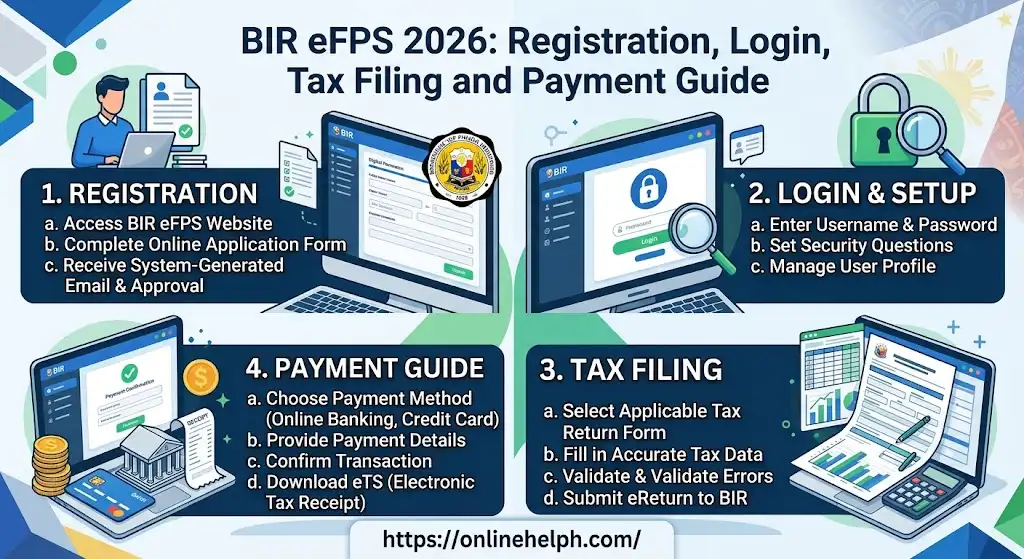
provides an online way for eligible taxpayers in the Philippines to manage certain tax-related transactions electronically. Through the BIR Electronic Filing and Payment System (eFPS), registered users can log in, prepare and submit tax returns, and complete applicable tax payments without relying entirely on manual processing. This guide explains the bir gov ph efps
registration and login process, tax filing steps, payment options, basic requirements, and common issues users may encounter. Whether you are a new eFPS user or an existing taxpayer looking for updated instructions, this complete guide will help you understand how to use the system more effectively. Visit Homepage for more
What Is BIR eFPS?
bir gov ph efps stands for Electronic Filing and Payment System. It is an electronic tax service operated by the Philippine Bureau of Internal Revenue.
The system is designed to facilitate electronic submission of tax returns and electronic payment of taxes through participating financial institutions. It reduces the need for eligible taxpayers to rely entirely on paper-based tax filing and provides an electronic process for submitting tax information.
Taxpayers using eFPS should still make sure that the information they enter is accurate and that they comply with the applicable BIR filing and payment deadlines.
For general tax information, forms, regulations, and other services, taxpayers can also visit the official:
Bureau of Internal Revenue (BIR) Website
Who Can Use BIR eFPS?
The bir gov ph efps may be used by taxpayers who are required or authorized to electronically file their tax returns through the system.
Potential users include:
The exact filing requirements can depend on the taxpayer’s classification and current BIR rules. Therefore, taxpayers should check the latest BIR instructions rather than assuming that every taxpayer uses exactly the same electronic filing procedure.
BIR eFPS Login: Step-by-Step Guide
Before you can use thebir gov ph efps for electronic filing, you need an active eFPS account.
The registration process generally involves online enrollment followed by validation or approval by the appropriate BIR office, depending on the taxpayer’s circumstances.
Step 1: Open the Official BIR eFPS Website
Go to the official bir gov ph efps website:
Always check that you are using the official BIR domain before entering your TIN, username, password, or other confidential information.
On the eFPS homepage, look for the enrollment option provided for new users.

Step 2: Select the eFPS Enrollment Option
From the bir gov ph efpslogin page, select “Enroll to eFPS” or the applicable enrollment option.
The system will take you to the electronic enrollment form. Read the instructions carefully before entering your information.
Avoid using another person’s information or an unofficial website when completing your registration.

Step 3: Enter Your Taxpayer Information
During enrollment, you may be required to provide information associated with your BIR registration.
This can include:
For a head office, the branch code may be represented as 00000, where applicable.
Make sure the information entered in the eFPS enrollment form matches your official BIR registration records. Incorrect taxpayer information can cause problems during account validation or subsequent filing.

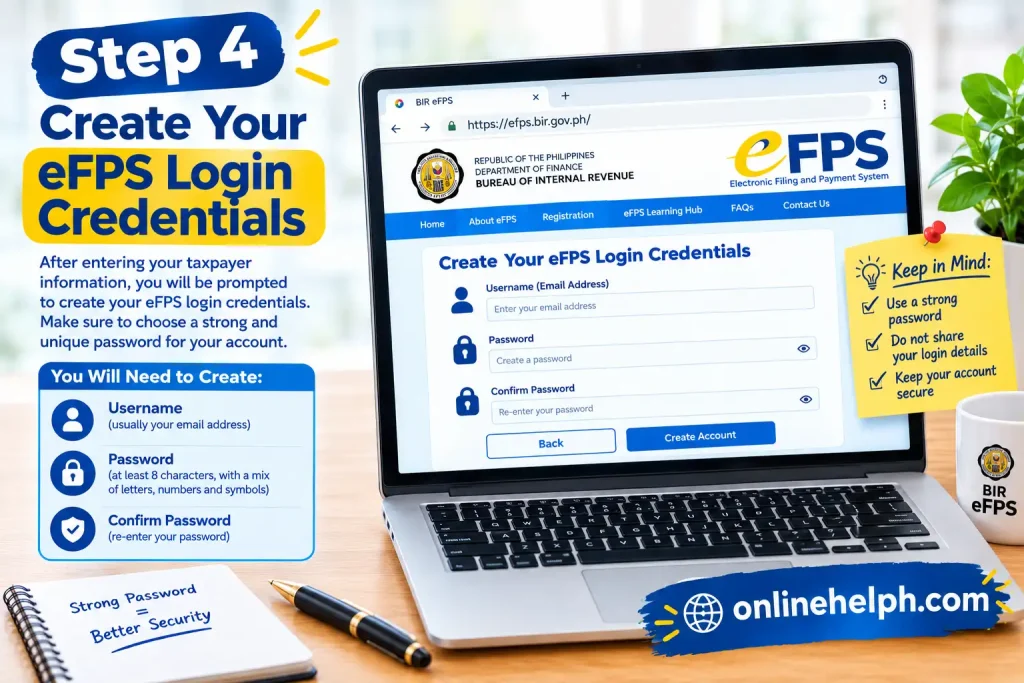
Step 4: Create Your eFPS Login Credentials
You will also need to create credentials for accessing your bir gov ph efps account.
Choose a username and password that are difficult for other people to guess. Do not share your eFPS password with colleagues, clients, or unauthorized individuals.
Security questions and answers should also be recorded securely because they may be needed for account recovery.
Step 5: Submit the Enrollment Form
After reviewing all the information, submit the online enrollment form.
If the system generates an eFPS Enrollment Confirmation Page, save or print it for your records.
This document can be important during the subsequent validation or activation process.

BIR eFPS Registration Requirements
The documents required during enrollment or validation can depend on the taxpayer type and BIR instructions applicable to the account.
Common supporting documents may include the following:
For Corporations and Partnerships
Depending on BIR requirements, a corporation or partnership may be asked to provide:
- Printed eFPS Enrollment Confirmation Page
- BIR Certificate of Registration (Form 2303)
- Secretary’s Certificate or Board Resolution, when applicable
- Valid government-issued identification of the authorized representative
- Other documents requested by the appropriate BIR office
For Sole Proprietors or Individuals
Possible documents include:
Important: Requirements can change depending on BIR procedures and taxpayer classification. Always confirm the current requirements with your assigned Revenue District Office (RDO) or the BIR before submitting documents.
Validation by the Appropriate BIR Office
Online enrollment does not necessarily mean that the account is immediately ready for use.
Where validation is required, the taxpayer may need to submit the enrollment confirmation and supporting documents to the appropriate Revenue District Office (RDO) or Large Taxpayers District Office (LTDO).
The BIR office can verify the taxpayer’s information and supporting documentation before activating the account.
Once your enrollment has been successfully approved, follow the activation instructions provided by BIR.
BIR eFPS Login: How to Access Your Account
After your account has been activated, you can access the bir gov ph efps portal using your registered credentials.
Step-by-Step eFPS Login
Step 1: Visit the Official bir gov ph efps Website
Open the official bir gov ph efps portal using the link below:
bir gov ph efps Login
Step 2: Enter Your Username
On the eFPS login page, enter your registered Username in the appropriate field.
Step 3: Enter Your Password
Type your registered Password carefully. Make sure Caps Lock is not accidentally enabled.
Step 4: Complete Security Verification
If the website displays a CAPTCHA or security verification, complete it as instructed before continuing.
Step 5: Click “Login”
After entering your credentials and completing the required verification, click the “Login” button.
Step 6: Access Your eFPS Account
If your username and password are correct and your account is active, you should be directed to the bir gov ph efps user interface/dashboard, where you can access the available electronic tax services.
What If You Cannot Log In?
If you cannot access your bir gov ph efps account, first check the following:
Avoid repeatedly entering an uncertain password because multiple unsuccessful attempts may result in temporary account restrictions depending on the system’s security controls.
BIR eFPS Dashboard and Tax Filing
After successful login, the eFPS dashboard provides access to the functions available to your account.
One of the most important functions is electronic tax-return filing.
The exact forms available to a taxpayer can depend on their registration, tax obligations, and current BIR requirements.
Common tax forms associated with electronic filing may include forms for withholding tax, VAT, income tax, and other tax obligations.
Before Filing a Tax Return
Before starting an eFPS filing, prepare the necessary information, including:
Carefully check your accounting records before submitting a return because electronically transmitted information can have compliance consequences.
How to File a Tax Return Using BIR eFPS
Once your bir gov ph efps account is active and you have successfully logged in, you can use the system to electronically prepare and submit applicable tax returns.
The tax return you need to file depends on your taxpayer registration, tax type, and current BIR requirements. Always select the correct form and taxable period before submitting anything.
Step 1: Open the Tax Returns Menu
After logging in to the official bir gov ph efps portal, go to the tax-return section available from your eFPS dashboard.
Look for the appropriate Tax Returns option and select the form applicable to your tax obligation.
bir gov ph efps Official Portal
The available forms can vary depending on the taxpayer’s registration and obligations.
Step 2: Select the Correct BIR Tax Form
Choose the appropriate return from the available list.
Depending on the taxpayer and tax obligation, examples of BIR forms that may be encountered include:
These examples are provided for guidance only. The correct form depends on your specific tax liability and the BIR rules applicable to your taxpayer registration.
Selecting the wrong form can result in an incorrect filing, so review your tax records before proceeding.
Step 3: Select the Taxable Year and Return Period
After selecting a form, enter the appropriate taxable year and return period.
Depending on the form, the system may ask for:
Check these details carefully before entering financial information.
For example, filing a return for the wrong quarter can create a compliance problem even if all the financial figures are correct.
Step 4: Enter Your Tax Information
Complete the required fields in the electronic tax return.
Some taxpayer information may already appear based on your eFPS account and BIR records. However, you should still review the information before continuing.
Depending on the return, you may need to enter information such as:
Enter amounts exactly as supported by your accounting records and relevant documents.
Review Before Validation
Before clicking the validation option, check:
A simple typing error can affect the calculated tax amount, so take time to review the return.
Step 5: Validate the Return
After completing the form, use the available Validate function.
The EFPS stands for system can identify certain missing information, incorrect entries, or validation errors.
If an error appears, return to the relevant field and correct the information.
Do not proceed to final submission until the return has passed the applicable validation checks.
Common Validation Problems
Some common reasons a return may not validate correctly include:
If you are unsure why a particular validation message appears, review the instructions associated with the form or contact BIR through its official support channels.
Step 6: Finalize and Submit the Tax Return
After checking the return and correcting any errors, proceed with the electronic submission.
The system may display a confirmation or finalization step before the return is transmitted.
Review the information one final time before confirming.
Once submitted successfully, the return is electronically transmitted through the EFPS stands for system.
Do not close the browser immediately after submission. Wait for the system to display the appropriate confirmation or reference information.
What Is an FRN in BIR eFPS?
An FRN, or Filing Reference Number, is an important reference generated in connection with an electronic filing.
After successfully submitting a tax return through ., taxpayers should carefully record the FRN displayed by the system.
The FRN can help you identify and track the electronic filing and may also be needed when proceeding with the associated payment process.
How to Save Your FRN
After the return has been successfully submitted:
It is a good practice to maintain the FRN together with the corresponding tax return and payment documentation.
Step-by-Step BIR eFPS Payment
Step 1: Proceed to Payment
After successfully filing the return, follow the payment option presented by eFPS, where applicable.
You may also access the relevant pending payment or filing information from your account.
The payment amount should correspond to the tax liability shown on the filed return.
Step 2: Select the Available Payment Channel
Select the applicable electronic payment option provided by the eFPS system.
Depending on the current BIR arrangements and your taxpayer’s eligibility, the system may provide payment through an Authorized Agent Bank (AAB) or another supported electronic channel.
Do not assume that every bank or payment method is available to every taxpayer.
Step 3: Choose Your Authorized Agent Bank
If the AAB payment option is available, select the appropriate participating bank from the choices provided by the system.
Examples of financial institutions that have participated in BIR electronic tax-payment arrangements include:
Important: Bank participation, names of online banking services, and eFPS integration arrangements can change. Use the options currently displayed by the official www bir gov efps system rather than relying solely on an older list.
Step 4: Authenticate Through Your Bank
Depending on the payment arrangement, you may be redirected to the selected bank’s online banking environment.
Enter your authorized banking credentials only on the legitimate bank website or banking interface.
You may be required to provide additional authentication, such as:
Never provide your banking password or OTP to another person.
Step 5: Review the Payment Details
Before authorizing the transaction, carefully review:
If anything appears incorrect, stop and verify the transaction before authorizing it.
Step 6: Authorize the Payment
Once you have confirmed the details, authorize the electronic payment using the security procedure required by your bank.
Do not refresh the browser or close the banking window while a transaction is being processed unless the bank specifically instructs you to do so.
After successful processing, wait for the payment confirmation.
Step 7: Save the Payment Confirmation
Keep the electronic payment confirmation or reference number generated after the transaction.
Your records may include:
Keeping these documents together makes it easier to demonstrate compliance and investigate discrepancies later.
BIR eFPS Filing vs. Payment
It is important to understand that filing a return does not necessarily mean that the tax has been paid.
For a return with tax due, you generally need to complete both applicable processes:
www bir gov efps filing → Filing confirmation/FRN → Payment → Payment confirmation
If you file a return but do not complete the required payment, the tax obligation may remain outstanding.
Therefore, taxpayers should verify both their filing status and payment status.
What Is a Filing Reference Number Used For?
The FRN is useful for maintaining an organized tax record.
You should keep the FRN because it can help you identify the electronic transaction associated with a particular return.
For business taxpayers, accountants can maintain a filing record containing:
| Record | Purpose |
|---|---|
| Tax return | Shows information submitted to BIR |
| FRN | Identifies the electronic filing |
| Payment confirmation | Shows payment transaction |
| Bank reference | Helps identify the banking transaction |
| Supporting documents | Provides evidence for accounting records |
Maintaining these records electronically can make future reconciliation and tax compliance work much easier.
Important Tips Before Using BIR eFPS
To avoid unnecessary problems, prepare your return before beginning the online filing process.
Keep Your Accounting Records Ready
Do not start entering figures into eFPS without having the necessary accounting information available.
Prepare the relevant:
File Before the Deadline
Avoid waiting until the final hours before a statutory deadline.
High website traffic, internet interruptions, banking maintenance, or other technical problems can make last-minute electronic filing risky.
Submitting early gives you more time to correct errors if the system rejects a return or a payment transaction does not complete as expected.
Use a Secure Device
When accessing www bir gov efps, use a trusted computer and a secure internet connection.
Avoid accessing your taxpayer account from public computers or unsecured networks.
Also make sure that your browser is updated and that you are using the official BIR website.
BIR eFPS Common Problems and Solutions
Although the www bir gov efps provides a convenient way to file tax returns electronically, users may sometimes experience login, browser, filing, or payment problems. Many issues can be resolved by checking account details, internet connectivity, browser settings, or the transaction status before attempting the same action again.
Below are some common www bir gov efps problems and practical steps to consider.
BIR eFPS Login Not Working
If your eFPS login is not working, first check that you are using the correct username and password.
You should also:
Always use the official portal:
www bir gov efps Official Website
Forgotten BIR eFPS Password
If you forget your password, use the account-recovery or Forgot Password facility available on the official eFPS website.
Follow the instructions displayed by the system and provide only the information requested through the official BIR portal.
If the recovery process does not work, you may need to contact the appropriate BIR office or eFPS support personnel for assistance.
Never give your password or security information to someone claiming that they can unlock your account for a fee.
BIR eFPS Account Locked
An account can become inaccessible after repeated unsuccessful login attempts or because of other account-security controls.
If your account is locked:
The exact account-recovery process may depend on the current eFPS system and your taxpayer account.
BIR eFPS Website Is Slow or Unavailable
Sometimes an online government portal may become slow because of heavy traffic, maintenance, internet connectivity problems, or other technical issues.
If www bir gov efps is not responding properly, try:
For important tax deadlines, avoid leaving your filing until the final minutes.
BIR eFPS Payment Problem
Payment problems require extra caution.
If you clicked the payment option but are unsure whether the transaction was completed, do not immediately submit another payment.
First check:
This can help prevent accidentally making the same payment twice.
If money was deducted from your bank account but the eFPS payment status does not appear correctly, keep the bank transaction details and contact the relevant BIR or bank support channel.
What If the Bank Payment Gateway Disconnects?
A browser session can sometimes expire or a connection between the filing process and banking environment can be interrupted.
If this happens, check the transaction status before attempting another payment.
Also consider:
The most important rule is verify first, retry second.
BIR eFPS Payment Cut-Off and Deadlines
Taxpayers should not rely on the final minutes of a filing deadline to complete both filing and payment.
Bank processing schedules, system maintenance, internet interruptions, and other technical issues can affect the completion of electronic transactions.
For this reason, it is safer to prepare your return and complete the applicable payment process ahead of the deadline.
Tax deadlines and payment rules can vary according to the return and taxpayer classification. Always check the latest official BIR announcements and instructions.
Bureau of Internal Revenue Official Website
BIR eFPS Security Tips
Because eFPS involves sensitive taxpayer and financial information, account security is extremely important.
Use Only the Official Website
Always verify that you are accessing the official www bir gov efps domain:
Avoid websites that imitate the BIR login page.
Protect Your Password
Never share your eFPS password with another person.
A legitimate BIR employee or bank representative should not need you to disclose your password.
Be Careful With OTPs
If your bank requires an OTP or another authentication method, enter it only into the legitimate banking interface associated with your transaction.
Never send an OTP to someone through Messenger, email, SMS, or another communication channel.
Save Your Filing Records
After completing your return, retain the applicable:
These records can be useful for reconciliation and future compliance purposes.
BIR eFPS vs. Manual Tax Filing
The primary advantage of www bir gov efps is that it provides an electronic method for eligible taxpayers to submit tax returns and, where supported, complete electronic tax payments.
A simplified comparison is:
| Feature | BIR eFPS | Manual Process |
|---|---|---|
| Tax return preparation | Electronic | Paper/manual or other applicable method |
| Filing | Online | Physical or applicable alternative |
| Filing reference | Electronic reference | Physical/other confirmation |
| Payment | Electronic channels where available | Depends on applicable payment method |
| Record keeping | Digital records can be saved | Physical documents may be required |
| Accessibility | Online | May require physical transactions |
However, the appropriate filing method depends on the taxpayer’s circumstances and current BIR regulations.
FAQs
Final Thoughts on BIR eFPS
The BIR eFPS provides an electronic way for eligible Philippine taxpayers to manage important tax-filing and payment activities. From account enrollment and eFPS login to tax-return submission, FRN generation, and electronic payment, understanding each stage can help taxpayers complete their obligations more efficiently.
The most important step is to use the official BIR eFPS website, enter accurate taxpayer information, select the correct tax return and period, carefully review the figures before submission, and save your filing and payment references.
If you encounter a technical problem, avoid repeatedly submitting the same transaction without first checking its status. Keeping your FRN, payment confirmation, and supporting records can also make future verification much easier.