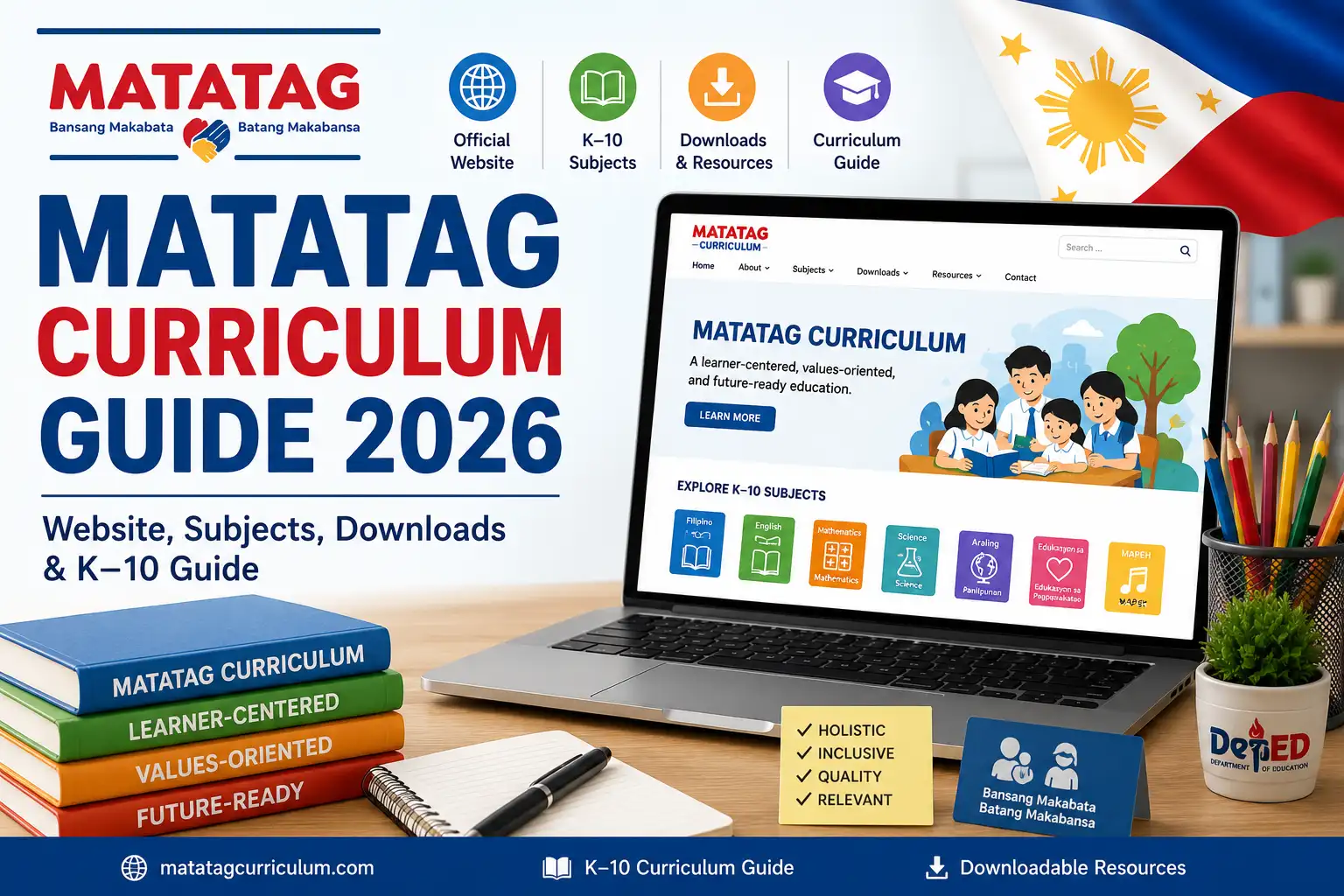
The MATATAG Curriculum is the Department of Education’s revised K–10 curriculum designed to make basic education more focused, relevant and manageable for Filipino learners. It places greater attention on foundational literacy and numeracy while giving schools and teachers clearer learning standards, competencies and progression across grade levels.
For teachers, parents and students looking for MATATAG Curriculum guides, the first thing to understand is that there are two useful sources. The website matatagcurriculum.com provides organised guides and downloadable resources,
What Is the MATATAG Curriculum?
MATATAG is the revised basic education curriculum introduced by the Department of Education (DepEd) in the Philippines. Rather than requiring learners to move rapidly through a large number of competencies, the framework gives greater weight to essential knowledge and skills that students need at each stage of development.
The curriculum is intended to support stronger foundations in reading, writing and mathematics while also developing communication, critical thinking, creativity, collaboration and other skills needed beyond school.
The name MATATAG reflects the programme’s broader educational direction. Its themes include being Makabansa, caring for Tao at Kalikasan, strengthening learners as Tagapagtaguyod, and building a child-centred education system. The programme is associated with the motto “Bansang Makabata, Batang Makabansa.”
One of the most important ideas behind the MATATAG Curriculum is decongestion. Instead of treating curriculum coverage as the main goal, teachers can spend more time helping learners understand and apply essential concepts. visit for Homepage
Why Was the MATATAG Curriculum Introduced?
The revision responds to concerns about the amount and sequencing of learning competencies in the previous curriculum. DepEd’s revised framework aims to make learning more focused and developmentally appropriate, particularly in the early grades.
The result is a curriculum that gives greater prominence to:
The official DepEd curriculum documents describe learning standards, competencies and performance expectations that guide teaching and assessment. For example, the MATATAG Mathematics guide defines key-stage standards, grade-level standards, content standards, learning competencies and performance standards as parts of the curriculum structure. Official site
How to Create an Account
Step 1: Navigate to the Registration Page
Open your web browser and visit the official portal homepage. Locate and click the Sign Up, Register, or Create Account button, typically positioned in the top-right corner of the navigation bar.

Step 2: Enter Your Personal Details
Fill out the required registration fields with accurate information:

Step 3: Set a Secure Password
Create a strong password that meets standard security guidelines:

Step 4: Verify Your Email Address
Check your email inbox for an automated confirmation message from the platform. Open the email and click the provided Verify Account button or activation link to authenticate your request. (If the email does not appear within 5 minutes, check your Spam or Junk folder).

Step 5: Complete Your Profile & Log In
Return to the main login screen, enter your verified email address and newly created password, and sign in. Once authenticated, you will have immediate access to personalized dashboard tools, account-restricted resources, and downloadable files.

MATATAG Curriculum Key Stages Explained
Understanding the MATATAG Curriculum key stages makes it easier to find the right guide for a learner. K–10 education is organised into three major stages:
| Key Stage | Grades | Main Educational Focus |
|---|---|---|
| Key Stage 1 | Kindergarten–Grade 3 | Foundations, language, literacy, numeracy and values |
| Key Stage 2 | Grades 4–6 | Skill development, subject mastery and practical learning |
| Key Stage 3 | Grades 7–10 | Deeper academic learning, critical thinking and preparation for future pathways |
Key Stage 1: Kindergarten to Grade 3
The first stage establishes the basic skills children need for later learning. The emphasis is on language development, early reading, numeracy, social and emotional growth, values and national identity.
The MATATAG approach gives particular importance to making the early years less overloaded. Learners should have sufficient time to practise and master basic skills instead of simply moving from one competency to another.
For Kindergarten, the redesigned curriculum also takes a learner-centred and play-based approach. DepEd’s shaping paper describes developmental areas including socio-emotional development, values, physical health and motor development, aesthetics and creativity, cognition, language, literacy and communication.
Key Stage 2: Grades 4–6
Grades 4 to 6 build on the foundations developed in the early years. Students encounter broader learning areas and begin applying knowledge through more structured academic, practical and creative activities.
This stage also develops practical competencies through EPP/TLE. The official EPP/TLE curriculum explains that Grades 4–6 learners explore areas including ICT, Agriculture and Fishery Arts, Family and Consumer Science, and Industrial Arts.
Key Stage 3: Grades 7–10
The final K–10 stage introduces more advanced concepts and greater subject specialisation. Students develop analytical thinking, scientific reasoning, communication and practical competencies while becoming more aware of future education, career and livelihood possibilities.
The EPP/TLE framework, for example, progresses from basic skills in Grades 4–6 to common competencies in Grades 7–8 and more specialised technical and entrepreneurial competencies in Grades 9–10.
MATATAG Curriculum Subjects by Grade Level
The exact learning areas vary according to grade level, so parents and teachers should always check the relevant MATATAG Curriculum Guide PDF rather than assuming every subject applies to every grade.
In the early grades, the curriculum places strong emphasis on language, reading, mathematics, values and Makabansa. As learners progress, the learning areas broaden to include subjects such as Science, Araling Panlipunan, MAPEH and EPP/TLE.
Early-Grade Learning Areas
The supplied MATATAG framework highlights the following structure:
Grade 1
Grade 2
Grade 3
The official curriculum PDFs provide the detailed competencies and quarterly progression for individual learning areas. For example, the English guide sets out learning competencies across areas such as phonological awareness, phonics, listening, reading, speaking and writing.
What Changes as Students Reach Grades 4–10?
From the middle grades onward, learners encounter a wider range of disciplines. Common learning areas include:
The structure is intended to build skills progressively rather than treating each grade as an isolated set of topics.
For example, the MATATAG Physical Education and Health framework focuses on developing physical and health literacy for active and healthy living.
Key Takeaway for Parents and Students
If you’re searching for a MATATAG Curriculum guide, don’t rely only on a subject list. The most useful document is the Curriculum Guide for the learner’s specific grade and learning area, because it contains the standards and competencies that apply to that level.
Teachers can use these documents when preparing lessons, while parents can use them to understand what their children are expected to learn during the school year.
MATATAG Curriculum PDFs and Learning Resources
For teachers, students, parents, and school administrators, one of the most useful parts of the MATATAG Curriculum is the availability of curriculum guides and supporting learning resources. These materials help users understand what learners are expected to study, what competencies should be developed, and how lessons can be organized during the school year.
The MATATAG Curriculum was introduced by the Department of Education (DepEd) to make the basic education curriculum more focused and responsive to learners. Instead of trying to cover too many competencies, the revised curriculum emphasizes essential learning areas and gives teachers more flexibility to develop meaningful classroom activities.
When searching for a MATATAG Curriculum PDF, always check the grade level, learning area, and school year or implementation phase. A curriculum guide for Kindergarten, for example, will not contain the same competencies or time allotments as a guide for Grade 4 or Grade 7.
Where to Find the MATATAG Curriculum PDF
The safest approach is to obtain curriculum documents from official DepEd sources or from the official MATATAG curriculum resource website being used for the particular guide. Avoid downloading random copies from unfamiliar websites when an official document is available.
Department of Education (DepEd) official website
The official DepEd website publishes curriculum-related issuances, announcements, learning resources, memoranda, and downloadable documents. Users should compare the title and publication details before treating a PDF as the current official version.
For convenient curriculum information and organized resources, users may also visit:
MATATAG Curriculum official resource website
How to Find the Correct MATATAG Curriculum Guide
Finding the correct MATATAG Curriculum Guide is easier if you identify three things first:
After identifying these details, open the PDF and check its title page. The document should clearly identify the learning area and grade level. Also look for DepEd references, publication information, or other details that help establish its authenticity.
What Information Is Included in a MATATAG Curriculum PDF?
A typical curriculum guide can contain several important sections. Depending on the learning area and grade level, you may find:
The most important section for teachers is often the learning competencies because these indicate what learners are expected to know, understand, or demonstrate.
Parents can also use the guide to understand the general direction of their child’s studies without attempting to replace the teacher’s lesson planning.
MATATAG Lesson Exemplars and Teaching Resources
Curriculum guides explain what learners are expected to achieve, while lesson exemplars and other teaching materials can provide ideas about how those competencies may be taught.
A lesson exemplar may include learning objectives, activities, discussion points, assessment tasks, and suggested resources. However, teachers should treat exemplars as instructional support rather than rigid scripts.
A teacher can adapt an activity according to:
This flexibility is particularly useful because classrooms are not identical. An activity that works well for one group may need modification for another.
MATATAG Class Programmes and Time Allotment
Another important concern is the MATATAG time allotment. Teachers and school administrators need to know how much instructional time is available for each learning area when preparing class programmes.
Time allotment should not be guessed from an old curriculum schedule. Schools should refer to the applicable DepEd guidance and the curriculum documents for the relevant grade level and implementation year.
When reviewing a class programme, check that:
Because implementation can be phased and official guidance can be updated, users should verify the latest DepEd issuance rather than relying on an old timetable shared on social media.
MATATAG Learning Resources
The MATATAG Curriculum works alongside learning resources that teachers can use to support classroom instruction. These may include textbooks, activity sheets, digital materials, teacher-developed resources, reference materials, and other DepEd-supported resources.
Teachers should evaluate any resource before using it in class. A useful resource should support the competency being taught rather than simply add more material for students to memorize.
A simple selection process is:
Curriculum competency → Learning objective → Appropriate resource → Classroom activity → Assessment
This approach helps keep teaching focused. If a worksheet, video, presentation, or activity does not support the intended competency, it may not be necessary.
Practical Guide for Teachers
Teachers using the MATATAG Curriculum can make the process easier by starting with the curriculum guide rather than immediately creating classroom activities.
First, identify the competency that needs to be addressed. Next, determine what learners should be able to demonstrate by the end of the lesson or learning sequence. After that, select an appropriate teaching strategy and learning resource.
A practical workflow is:
Step 1: Check the curriculum guide
Identify the applicable grade level, learning area, quarter, and competency.
Step 2: Define the learning objective
Convert the competency into a clear classroom objective that learners can understand.
Step 3: Select learning resources
Choose appropriate books, worksheets, digital materials, examples, or teacher-created resources.
Step 4: Plan the activity
Create an activity that gives learners an opportunity to practice or demonstrate the target competency.
Step 5: Assess learning
Use an appropriate assessment to determine whether the objective was achieved.
Step 6: Adjust instruction
If learners struggle, provide additional explanation, practice, examples, or support instead of simply moving forward.
This process can make curriculum implementation more manageable and helps ensure that classroom activities remain connected to the official learning expectations.
Practical Guide for Students
Students do not normally need to study the entire MATATAG Curriculum PDF. The curriculum guide is primarily a planning document for educators and schools.
However, students can benefit from knowing the major learning areas and expectations for their grade level.
If you are a student looking for curriculum information, focus on:
If you find a MATATAG PDF online, do not assume that every topic inside it applies to your class. Check the grade level and learning area first.
Practical Guide for Parents
Parents can use the MATATAG Curriculum as a reference when supporting their children’s education at home.
For example, a parent can review the relevant curriculum guide to understand the general learning expectations for a particular grade level. This can make conversations with teachers easier and help parents select suitable supplementary activities.
Parents should avoid turning the curriculum guide into a second textbook. The purpose is to understand the learning direction and support the child—not to overwhelm the learner with additional lessons.
FAQS
conclusion
The MATATAG Curriculum marks a pivotal evolution in the Philippine basic education system, pivoting towards core learning competencies, essential literacy, numeracy, and foundational character building. By decluttering the instructional schedule and aligning targets with developmental milestones, educators can concentrate on deep, impactful instruction rather than racing through an overwhelming syllabus.
For teachers, the official curriculum guide serves as the main blueprint for daily lesson planning, competency tracking, assessment strategies, class scheduling, and resource selection. Parents and pupils can also consult these documents to understand learning expectations at each key stage. Because DepEd is rolling out the program in stages, stakeholders should verify the specific grade, subject, academic year, and latest official guidelines before utilizing any material.